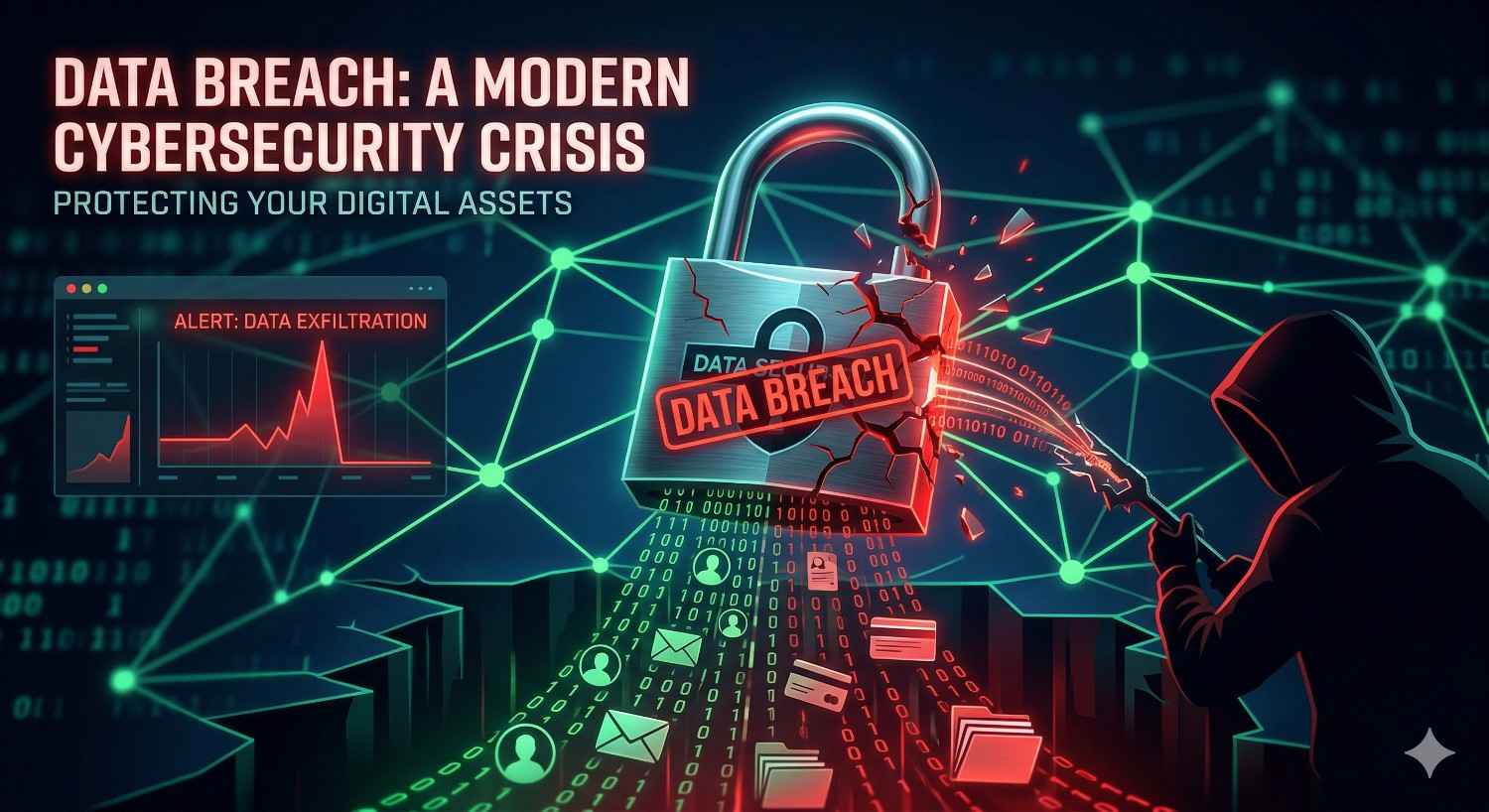

The Modern Reality of Cyber Warfare and Data Exposure
We exist in an era where digital footprints are expanding exponentially. Every application you download, every website you register on, and every transaction you make leaves a permanent mark on servers located thousands of miles away. In this interconnected ecosystem, a data breach is no longer a rare anomaly; it is an inevitable mathematical certainty for any organization storing valuable information. The concept of "Data Breach Protection" has evolved from a corporate buzzword into an absolute necessity for both multinational conglomerates and everyday internet users.
But to truly understand how to protect against these invisible threats, we must first dissect the anatomy of the threat itself. Hackers do not simply "break into" systems using magic; they exploit predictable human errors, outdated software architecture, and misconfigured cloud environments to extract the new oil of the 21st century: your personal data.
What Exactly Is a Data Breach?
A data breach occurs when secure, private, or confidential information is intentionally or unintentionally released into an untrusted environment. While Hollywood often portrays cyber attacks as hooded figures furiously typing green code onto black screens, the reality is far more methodical. A breach might be the result of a highly sophisticated Advanced Persistent Threat (APT) group backed by a nation-state, or it could simply be a junior developer accidentally leaving a massive AWS S3 bucket accessible to the public internet.
The stolen data usually falls into three distinct categories:
- Personally Identifiable Information (PII): This includes your full name, physical address, Social Security Number, date of birth, and driver's license details. PII is the foundation of identity theft.
- Financial Data: Credit card numbers, bank account routing details, and cryptocurrency wallet private keys. This data is the most immediately lucrative for cybercriminals.
- Digital Credentials: Usernames, email addresses, and plaintext or hashed passwords. These are aggregated into massive "combo lists" used to compromise secondary accounts.
The Lifecycle of a Data Breach
Understanding data breach protection requires understanding how the attackers operate. Every successful breach follows a specific methodology known as the Cyber Kill Chain. By recognizing these stages, cybersecurity professionals can deploy defensive measures to break the chain before the data is extracted.
Stage 1: Reconnaissance
Before launching an attack, threat actors spend weeks or months gathering intelligence. They use Open-Source Intelligence (OSINT) tools to scan a company's external network footprint, looking for unpatched VPN endpoints, exposed administrative portals, or misconfigured API gateways. They also scour LinkedIn to map out the company's organizational chart, identifying key employees in IT or finance who could be targets for spear-phishing.
Stage 2: Weaponization and Delivery
Once a vulnerability is identified, the attacker creates a tailored weapon. This could be a malicious PDF document containing a zero-day exploit, or a highly convincing phishing email designed to look like an urgent internal memo from the CEO. The delivery method relies heavily on social engineering, exploiting human psychology—fear, urgency, or curiosity—to trick an employee into opening the door.
Stage 3: Exploitation and Installation
The moment the payload is delivered and executed, the exploitation begins. The malware silently installs a backdoor on the victim's machine, establishing a Command and Control (C2) connection back to the hacker's servers. At this point, the attacker has a foothold inside the corporate network, but they do not yet have the data.
Stage 4: Lateral Movement and Privilege Escalation
A single compromised laptop in the HR department is rarely the ultimate goal. The attacker will use tools like BloodHound or Mimikatz to map the active directory, searching for paths to escalate their privileges. Their objective is to find a Domain Admin account. Once they obtain administrative rights, they can move laterally across the network completely undetected, bypassing standard antivirus software because they are now operating as a legitimate, highly trusted user.
Stage 5: Extraction (Exfiltration)
Finally, the attacker locates the central database containing the PII or financial records. Because downloading gigabytes of data might trigger network alarms, the attacker will often compress and encrypt the stolen files, transferring them slowly out of the network in small, disguised packets. By the time the security team notices the anomaly, the data is already being auctioned on dark web forums.
What is Data Breach Protection?
Data breach protection is not a single software application or a firewall; it is a holistic, multi-layered strategy designed to defend an infrastructure at every point in the Cyber Kill Chain. It operates on the philosophy of "Defense in Depth," ensuring that if one layer of security fails, another is there to stop the attack.
Proactive vs. Reactive Security
Historically, cybersecurity was largely reactive. Companies would build a strong perimeter (a firewall) and assume everything inside was safe. If an attacker breached the perimeter, alarms would sound, and the IT team would react. Today, the perimeter no longer exists due to remote work and cloud computing.
Modern data breach protection is proactive. It assumes that the network is already compromised and focuses on limiting the damage. This approach is called "Zero Trust Architecture." Under Zero Trust, no user, device, or application is inherently trusted, regardless of whether they are inside or outside the corporate network. Every single request for data access must be continuously authenticated and authorized.
The Core Pillars of Corporate Data Protection
For organizations entrusted with vast amounts of user data, implementing robust protection mechanisms is both a technical requirement and a legal obligation.
1. Advanced Encryption Standards
Encryption is the ultimate safety net. Even if a hacker successfully bypasses all firewalls and steals a database, strong encryption renders the data completely useless to them. Data must be encrypted both "at rest" (when stored on servers) and "in transit" (when traveling across the network). Modern hashing algorithms like Argon2id or bcrypt ensure that even if a password database is stolen, cracking the passwords requires more computational power than the attacker possesses.
2. Identity and Access Management (IAM)
The principle of least privilege states that a user should only have the minimum access rights necessary to perform their job. If an attacker compromises a customer service representative's account, IAM protocols ensure that the attacker cannot access the core financial database. Strict access controls significantly reduce the "blast radius" of a compromised account.
3. Endpoint Detection and Response (EDR)
Traditional antivirus software relies on known signatures to block viruses. EDR, however, utilizes artificial intelligence and behavioral analytics to monitor every device (endpoint) on the network. If an HR laptop suddenly starts trying to access the engineering source code repositories at 3:00 AM, the EDR system will instantly isolate the machine from the network, preventing lateral movement.
The Danger of Credential Stuffing and Password Reuse
While companies spend millions on sophisticated enterprise security, the most common cause of a data breach is devastatingly simple: password reuse. Over 65% of internet users recycle the same password across multiple platforms.
When a minor website is breached and its user database is dumped online, hackers deploy automated scripts called "credential stuffers." These scripts take the millions of leaked email/password combinations and systematically test them against high-value targets like online banking portals, Amazon, and PayPal. Because humans are predictable, a significant percentage of those combinations will successfully unlock other accounts. This creates a domino effect, where one small breach completely destroys an individual's digital identity across the entire internet.
Personal Data Defense: A 10-Step Blueprint
Data breach protection is not just a corporate responsibility; it is an individual necessity. You cannot control the security infrastructure of the companies holding your data, but you have absolute control over your personal attack surface. Here is a comprehensive blueprint to lock down your digital life.
1. Adopt a Zero-Trust Password Strategy
Never, under any circumstances, memorize a password. If a password is simple enough to remember, it is simple enough for an AI to crack. Utilize a reputable, zero-knowledge Password Manager. Generate 24-character, completely random, alphanumeric passwords for every single account you create. The only password you ever need to know is the master key to your vault.
2. Mandate Hardware-Based Two-Factor Authentication (2FA)
A password is only half of the lock. Two-Factor Authentication requires a secondary proof of identity. However, not all 2FA is equal. SMS-based 2FA is highly vulnerable to SIM-swapping attacks, where a hacker bribes or tricks a telecom employee into transferring your phone number to their SIM card. Instead, use an Authenticator App (like Google Authenticator or Authy) which generates time-based, one-time passwords (TOTP) locally on your device. For ultimate security, invest in a physical hardware key (like a YubiKey) that requires physical touch to authenticate.
3. Compartmentalize with Email Aliasing
If you use a single email address for your bank, your social media, and random newsletters, you are providing hackers with half of the login equation for your entire life. Use email aliasing services to generate unique, forward-only email addresses for every service you sign up for. If a specific service is breached, you simply disable that specific alias, and your primary, highly-secure inbox remains completely hidden from the dark web.
4. Institute a Credit Freeze
If your Social Security Number is exposed in a breach, identity thieves will attempt to open credit cards or take out loans in your name. By placing a security freeze on your credit reports with the three major bureaus (Equifax, Experian, and TransUnion), you block lenders from accessing your file. Without a credit report, new accounts cannot be opened. A credit freeze is free, highly effective, and can be temporarily lifted when you actually need to apply for credit.
5. Monitor the Dark Web Proactively
Do not wait for a company to send you a legal notice six months after they were hacked. Utilize reputable OSINT databases and secure checking tools to continuously monitor your email addresses and phone numbers. If your data appears in a new combo list, you need to know within minutes, not months.
6. Secure Your Local Network
Your home router is the gateway to all your connected devices. Ensure the router's firmware is updated regularly to patch known vulnerabilities. Change the default administrative password immediately, disable remote management features, and set up a separate guest network for smart home devices (IoT) so they cannot access your personal computers or NAS drives.
7. Beware of Sophisticated Phishing
Phishing has evolved far beyond poorly spelled emails from fake princes. Today's phishing campaigns use generative AI to perfectly mimic the tone, formatting, and branding of your bank or employer. Always verify the sender's actual email address, never click on links in unsolicited messages, and independently navigate to the official website if you receive a notification regarding your account.
8. Encrypt Your Local Devices
If your laptop or smartphone is physically stolen, a password alone will not protect your data; an attacker can simply remove the hard drive and read the files directly. Ensure full-disk encryption (like BitLocker for Windows or FileVault for macOS) is enabled. This mathematically locks the drive, ensuring the data remains completely inaccessible without the decryption key.
9. Minimize Your Data Footprint
Every time you provide a company with your data, you are creating a new liability. Do you really need to give a random mobile game your exact date of birth or your real name? Practice data minimalism. Provide fake information for non-essential services. The less real data you input into the digital ecosystem, the less data there is to be breached.
10. Regular Security Audits
Set a calendar reminder every 90 days to perform a personal security audit. Review the active sessions on your Google and social media accounts to ensure there are no unrecognized devices logged in. Review the third-party applications that have access to your accounts and revoke permissions for apps you no longer use.
The Future of Data Security: AI, Quantum Encryption, and Passkeys
The arms race between cybersecurity defenders and threat actors is accelerating rapidly. As we move further into the 2020s, several revolutionary technologies are set to change the paradigm of data breach protection.
Artificial Intelligence is currently a double-edged sword. While hackers use AI to write polymorphic malware and generate hyper-realistic phishing emails, defenders are utilizing machine learning to detect anomalies in network traffic with unprecedented accuracy, stopping attacks in milliseconds before human analysts even realize an intrusion is occurring.
Passkeys represent the most significant leap forward in personal security in decades. Developed by the FIDO Alliance (supported by Apple, Google, and Microsoft), Passkeys aim to eradicate the password entirely. Instead of typing a password, your device generates a unique cryptographic key pair. The private key never leaves your device, and you authenticate using biometrics (FaceID or a fingerprint). Because there is no password stored on the company's server, there is nothing for a hacker to steal during a database breach. This technology renders credential stuffing and phishing attacks completely obsolete.
Looking further ahead, the advent of Quantum Computing poses a theoretical threat to modern encryption standards. Quantum computers could potentially crack current RSA encryption in hours rather than millennia. In response, cryptographers are already developing and standardizing Post-Quantum Cryptography (PQC) algorithms, ensuring that the sensitive data stolen and hoarded by nation-states today remains undecipherable in the quantum era of tomorrow.
Conclusion: Security is a Process, Not a Product
Data breach protection is an ongoing journey, a continuous cycle of threat assessment, mitigation, and adaptation. The illusion of perfect security is the greatest vulnerability of all. By understanding the sophisticated mechanics of how breaches occur, demanding stringent protective measures from the organizations we trust, and taking uncompromising control over our personal digital hygiene, we can navigate the perilous landscape of the modern internet with confidence and resilience.
Remember, the goal is not to become completely invisible—that is impossible in the modern world. The goal is to make your data so difficult, time-consuming, and unprofitable to steal that the attackers simply move on to an easier target.
Sources & Further Reading
The information in this article is based on the following authoritative sources:
- CERT-In Advisory on Data Breaches — Official government advisories on data breach prevention for Indian users.
- NIST Cybersecurity Framework — National Institute of Standards and Technology framework for data protection.
- Google — Password Safety Guide — Google's official recommendations for password security and breach protection.
Pwned Checker is committed to citing official and authoritative sources. All external links open in a new tab.
Was Your Email Compromised in this Security Incident?
Cross-reference your email, username, or passwords against billions of verified breach records using our zero-log lookup engine.
Check Your Email for Free →